

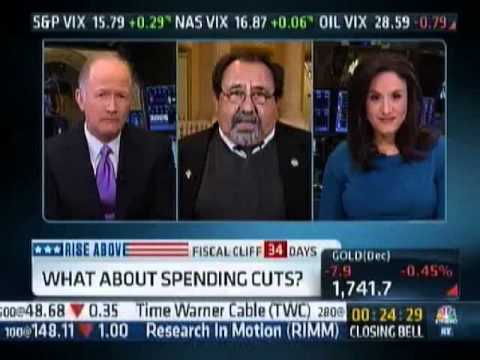
During an appearance on CNBC yesterday, Congressman Raul Grijalva said he’d rather go over the dreaded “fiscal cliff” than make a deal that dramatically cuts back on Medicare and Social Security benefits, which led to one of the most absurd questions The Range has ever heard from a professional TV journalist.
Host Michelle Caruso-Cabrera informed Grijalva that “as we’re talking the market is selling off once again. Every time members of Congress come on, and I’ve got to tell you sir, I think you’re contributing to the fears that we’re going off the fiscal cliff because it doesn’t sound like there’s any compromise in what you’re saying. Do you care that markets are selling off dramatically when it looks like you guys can’t come to a deal?”
Where to start with this one? First, Caruso-Cabrera perhaps overestimates her influence if she believes that traders are basing their decisions on her interviews. If she were pavement, would she assume that every time she got wet, she made it rain?
More importantly: She is doing a terrible job of actually explaining what the fiscal cliff really is to viewers. While “fiscal cliff” sounds really super-scary, it really means that tax rates will return to Clinton-era rates, while some drastic cuts will occur in the federal budget. On the bright side, that will actually go a long way toward resolving the deficit that is the greatest threat to our liberty and freedom ever, according to certain GOP politicians who now seemed terrified that spending cuts and tax hikes will bring revenues in line with expenditures if the fiscal cliff is not averted.
On the not-so-bright side, those tax hikes and spending cuts would eventually lead to a serious reduction in government services and a contraction in the economy, which would probably plunge the country back into a recession Nobody wants that entire package, no matter what their rhetoric is.
But the important thing to realize is that those spending cuts and tax increases wouldn’t have immediate impact, unless dopes like Caruso-Cabrera manage to panic the public and the markets. Jonathan Chait over at New York Magazine sums it up here:
Going over the fiscal cliff and then doing nothing for another year would mean a huge tax hike and spending cut. But waiting until January would mean extremely gradual tax increases and spending cuts, ones that would not even begin to take place immediately, because Obama has the ability to delay their implementation. And even after they’re implemented, the effect would be gradual, and could subsequently be canceled out. It’s like saying if you go three weeks without food you’ll die so if dinner isn’t on the table at 6 o’clock sharp terrible consequences will follow.
The reason many liberals want to wait until January is that it would make a deal much easier to strike, and ensure that the result is on more liberal terms. Once the entire Bush tax cuts have expired, President Obama would no longer have to pry revenue out of tax-hating Republicans. He’ll have all the revenue he wants and more. He could offer them a tax cut. He’ll likewise have huge defense cuts to bargain away.
Slate’s Matthew Yglesias made a similar point earlier this month:
A salient fact about non-metaphorical cliffs is that falling over them is generally irreversible. If the cliff is high enough that falling off of it would kill you, then if you fall off you’re going to die and that’s the end of it. The “fiscal cliff” by contrast isn’t like that at all.
Rather, it’s a set of policy changes—mostly tax hikes plus some steep spending cuts—that if they were all locked into place would constitute a significant drag on economic growth over the course of a year. But if the Bush tax cuts fully expire on a Tuesday morning it’s not as if some catastrophe strikes on Wednesday where suddenly middle class families have no money. It’s true that if the new higher rates were to be locked in, then the medium-term drag on middle class take home pay would delay the deleveraging cycle and damage the recovery. But to resolve that, all you need to do is introduce a new package of middle class tax cuts on Wednesday afternoon, have congress pass it on Thursday, and then the president signs it on Friday. The fact that taxes were higher for three days—or even three weeks—is simply not that consequential.
Obviously to the extent that higher middle class taxes is bad, one day of them is worse than zero days and three days is worse than one day. But it’s a deeply banal situation. There’s no particularly large virtue to “averting” the fiscal cliff on Day N-3 versus “going over the fiscal cliff” and then fixing it in retrospect on Day N+3. If “going over the cliff” gives the White House leverage to lock a better medium-term fiscal policy in place, then going over the cliff is a no brainer. Because there is no cliff.
And if you’re feeling particular interesting in studying the fiscal-cliff today, here’s more Chait on the “fiscal cliff” in a piece that has an laugh-out-loud moment about an 8-year-old authority on the matter. A key point:
Most of the people trying to persuade you that the “fiscal cliff” is some kind of ticking doomsday clock for the economy aren’t trying to save the economy or even to ensure the long-term solvency of the budget. They are trying to ensure that the budget deal that does occur lands as close as possible to their own preferred terms.
I could be wrong, but after watching Caruso-Cabrera’s interview with Grijalva, I don’t think she has a preferred policy position. I think she’s just a nitwit who doesn’t understand what the “fiscal cliff” is.
But we suppose it’s possible that there is some minor chance that Grijalva could singlehandedly tank the market if he’s allowed back on TV. MSNBC says it cancelled an interview with Grijalva today because Obama was going to give a live address about the economy…but maybe they’re just scared about his economy-crashing superpowers.
This article appears in Nov 22-28, 2012.

perspective:
“Stare Into the Eye of This Insane Storm on Saturn”
http://www.wired.com/wiredscience/2012/11/…
I don’t know where the term fiscal cliff came from. But it’s totally misleading. And it’s scaring the daylights out of a lot of people. My guess is that it came from a Republican.
Is it something Frank Luntz made up?
After all we haven’t had a budget in three years and the debt keeps climbing. We keep sending money to countries that hate us. Why not go over the fiscal-cliff? Bankrupcy would hurt some aspects of the government, but it could fix part of the spending issues. I think this is a scare tactic by both parties to get their way.
“I could be wrong, but after watching Caruso-Cabrera’s interview with Grijalva, I don’t think she has a preferred policy position.”
Yes, you’re wrong. Aside from Rick Santelli, she’s the biggest cheerleader for the conservative/tea bag position on CNBC. The network has declined dramatically since Comcast became majority owner, increasingly interjecting politics into their programming and becoming more like Fox Business every day. Their current “Rise Above” campaign is a perfect example of the network acting less like journalists and more like a wing of the Republican party.
CNBC and its anchors and pundits are mouthpieces for Wall St. For Cabrera to blame Grijalva was about the most stupid & ridiculous thing I’ve ever heard! I refuse to watch these Wall St. apologists. If the Sequestration bill passed by both parties, is allowed to stand, Pentagon funding will be cut. The Pentagon’s already agreed to those cuts. Pres. Obama will have more leverage after the new year to get the middle-class tax cuts. There’s no “cliff” to fall off….except for the extremely greedy wealthiest to lose their tax cuts. Their greed knows no bounds.